Health News – August 2024
8 August 2024
Health News – October 2024
5 October 2024Dear faithful, occasional or new reader, welcome to the September edition of your favourite Health News roundup! With a non-stop sporting summer, for those football fans amongst us, the domestic leagues being once again in full swing, whilst the children are about to start their new terms, with summer holiday suitcases going back into the loft, enjoy these 4 selected health related articles:-
7th BBC News – Bone-Building Drug Coming for Post-Menopause Women
Tens of thousands of women who have gone through the menopause might benefit from a new bone-strengthening drug, says the medicines watchdog National Institute for Health and Care Excellence (NICE). Abaloparatide can protect against the bone-thinning condition called osteoporosis, which causes a high risk of broken bones in older age.
It will become available on the NHS in England within the next three months, says NICE. The injection, which comes as a pre-filled pen that people can self-administer at home once a day, encourages cells to make new bone. Other osteoporosis treatments are already available, but this new one is an alternative for people who have not responded to, or who cannot tolerate, those.
Theramex, which makes the medication, has agreed an undisclosed price with the NHS. By the time people are in their mid-20s, bone strength will have peaked. From then, it naturally declines. Getting enough vitamin D and calcium is also important for bone health. Hormone replacement therapy (HRT) around the time of the menopause can help too. Oestrogen levels drop, which can weaken the bones.
Prof Jonathan Benger, chief medical officer and deputy chief executive at NICE, said: “The independent committee heard from patients about how debilitating osteoporosis can be. Our focus is on enabling access to care that improves quality of life while offering value to the taxpayer.” More than three million people have osteoporosis in the U.K. The prevalence increases markedly with age – about 2% of women aged 50 have it compared with almost half of women who are 80, says NICE. More than one in three women and one in five men will sustain one or more osteoporotic fractures in their lifetime.
8th The i paper – A&Es in England Having Busiest Summer Ever as NHS Struggles to Cut Waiting Times
Some 4.6 million patients attended A&E over the past two months – higher than any other June and July. The latest performance data shows that the three busiest ever months for emergency staff have been in 2024 – 77,945 attendances per day in May, 76,469 in June and 74,459 in March.
More than three-quarters (75.2 per cent) of patients were seen within four hours in A&E in July, the highest proportion since September 2021 but still well below the target of 95 per cent. The number of patients waiting more than 12 hours in A&E departments from a decision to admit to actually being admitted stood at 36,806 in July, down from 38,106 in June, figures show. The number waiting at least four hours from the decision to admit to admission rose slightly, from 128,114 to 129,330.
Meanwhile, the waiting list for routine hospital treatment in England has risen for the third month in a row. An estimated 7.62 million treatments were waiting to be carried out at the end of June, relating to 6.39 million patients – up slightly from 7.60 million treatments and 6.37 million patients at the end of May, NHS England said.
Some 2,621 patients in England had been waiting more than 18 months to start routine treatment at the end of June, down sharply from 4,597 in May. The Government and NHS England set a target of eliminating all waits of more than 18 months by April 2023, excluding exceptionally complex cases or patients who choose to wait longer. There were 58,024 patients who had been waiting more than 65 weeks to start treatment at the end of June, up from 55,955 in May. The target to eliminate all waits of more than 65 weeks is now September 2024, having previously been March 2024.
A total of 302,693 people in England had been waiting more than 52 weeks to start routine hospital treatment at the end of June, down slightly from 307,500 at the end of May. Officials are aiming to eliminate all waits of more than a year by March 2025.
Reacting to the data, Danielle Jefferies, senior analyst at think tank The King’s Fund, said: “These figures are a stark reminder that the pressure in the NHS is not going away as it grapples with ongoing industrial action, tight public finances, and a rise in the number of beds occupied by patients with Covid-19. This is worrying because the NHS should be working now to prepare for winter, but instead providers are using their time and money to tackle immediate pressures.”
In cancer care, some 76.3 per cent of patients urgently referred in June were diagnosed or had the disease ruled out within 28 days. This is down very slightly from 76.4 per cent the previous month but is above the target of 75 per cent, which has only been exceeded four times since it was introduced in autumn 2021. GPs in England made 259,681 urgent cancer referrals in June, down from 270,583 in May and also down year-on-year from 261,191 in June 2023.
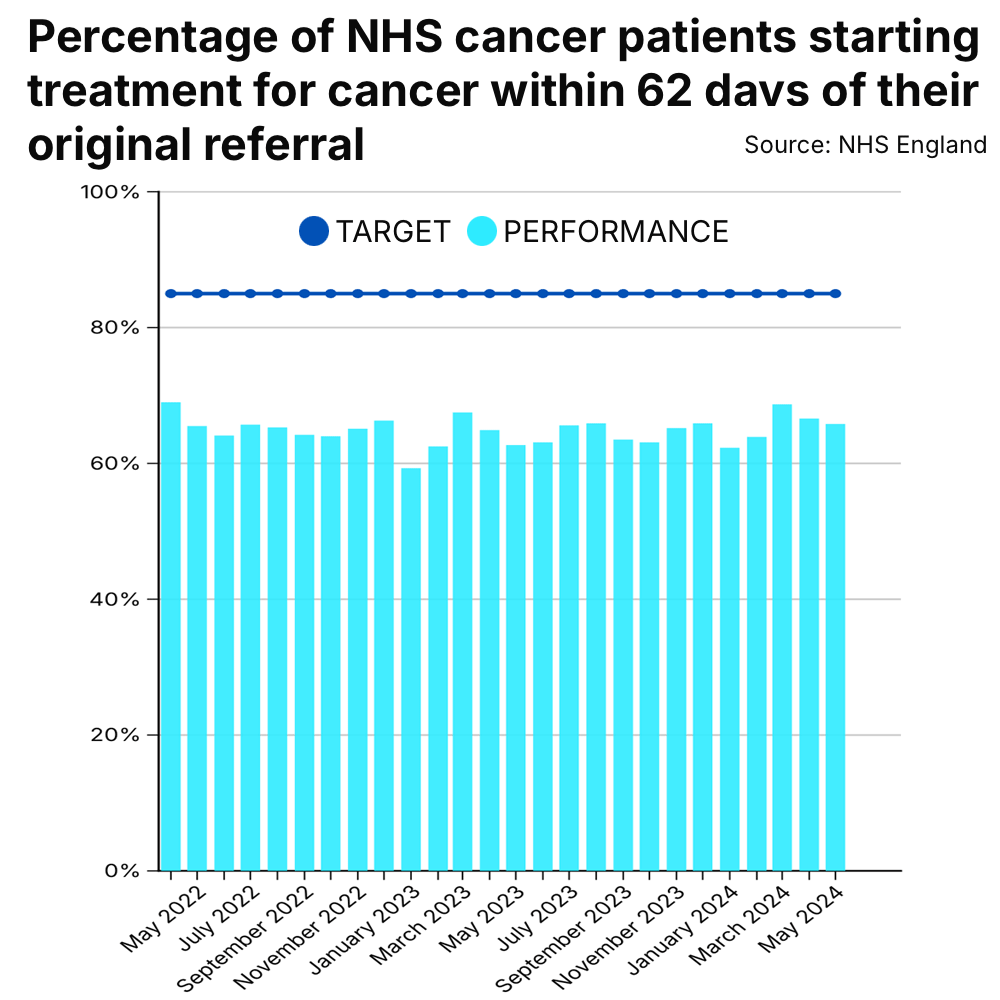
The proportion of patients waiting no longer than 62 days from an urgent suspected cancer referral or consultant upgrade to their first definitive treatment for cancer was 67.4 per cent, up from 65.8 per cent in May but below the target of 85 per cent. Louise Ansari, chief executive at Healthwatch England, said: “We are concerned that the progress made in speeding up both cancer diagnosis and the commencement of cancer treatment in recent months is slowing.”
“Despite some progress on the referral to treatment target, the NHS is still falling well short of its operational target that 85 per cent of patients wait less than two months between an urgent referral and treatment commencing. Urgent action is required to ensure that timely cancer diagnosis and treatment becomes the norm for all patients in England.”
22nd Alzheimer’s Society – Breaking: Lecanemab approved for use in the UK
For the first time, a disease-modifying treatment for Alzheimer’s disease has been approved for use in the UK. This morning, the Medicines and Healthcare products Regulatory Agency (MHRA) announced that Lecanemab – a treatment which has been shown to slow down the progression of Alzheimer’s disease – is safe and effective for use, with some exclusions.
However, the National Institute for Health and Care Excellence (NICE) have announced that they are not recommending Lecanemab for use on the NHS at this time. This is disappointing news and reflects the current challenges of how people living with dementia are diagnosed and treated.
27th HCA Healthcare UK – Mpox (previously monkeypox) Guidance
MPXV is a virus from the same family as smallpox, that presents with a rash which may be mild and localised, or severe and disseminated. There are 2 distinct clades of the virus: Clade 1 and Clade 11. Clade 11 MPXV is responsible for the global outbreak that began in 2022. Clade 1 MPXV is currently considered more severe than Clade 11 MPVX, leading to its classification as a high consequence infectious disease (HCID).
Historically, Clade 1 MPXV has been reported only in 5 Central African countries. However, recent cases in additional countries within Central and East Africa mark the first known expansion of its geographical range, heightening the risk of spread beyond the region, with more recent evidence of cases found in Sweden and Pakistan in August 2024. There are likely to be further cases around the world.
*******************************************
There’s another month’s roundup for you! New ground-breaking drugs becoming available, although not necessarily being initially available upon the NHS, with the summer A&E pile up having a knock on effect onto the waiting lists. Enjoy the last few days of summer, and until the more autumnal month of October please stay fit & healthy.
Kind Regards
Daniel Donoghue
Specialist ‘Whole of Market’ Broker
Surrey Circle Health