Health News – July 2024
10 July 2024
Health News – September 2024
6 September 2024Dear loyal reader, After 3 and a half years of monthly updates, every month there is always an abundance of good quality health related news available… If you keep your proverbial ‘ear to the ground’! I encourage you to tear yourself away from the compelling Parisian Olympics with all the passion and drama of these athletes who have dedicated their entire lives to their chosen sport, and in the words of the theme song of that children’s TV programme of the 1070’s, ‘Record Breakers’ (hosted by Roy Castle) – “If you want to be the best, dedication is what you need!”, to enjoy these 4 articles from the past month:-
3rd Health & Protection Magazine – Health MOTs and Private Treatment Top UK Employee Wellness Wish List
Health MOTs and employee support for private diagnosis and treatment jointly top the wellbeing benefits wish list for UK employees, with seven out of ten people (70%) rating them valuable. The results, released today, come from a survey by Find Out Now for Bluecrest Wellness.
Tying in first place at the top of in-demand health benefits were health MOTs and private diagnosis and treatment support, followed by cashback on opticians or dentists, rated valuable or very valuable by 68%, followed by physio sessions (60%), mental health support (55%) and GP access (54%).
The survey, conducted 22-28 March 2024, interviewed a nationally representative sample of 2,009 respondents, including 1,437 in employment. People were mostly interested in health assessments to find some peace of mind (61%) and identify health risks early (60%). The top things they wanted to know were their cancer risk (70%) and heart health (70%), followed by stroke risk (52%), and then blood health, kidney and liver function, blood pressure – and cholesterol.
Bluecrest had seen B2B and partnership revenue grow by 42% over the last year, and took the poll to understand that increase in demand, and explore changing attitudes to health and health benefits in the midst of increasing pressure on public health services. The poll also found that three quarters of employees are working when sick, and more than half are unwilling to make a GP appointment and take their symptoms to the doctor – often because they do not want to let down their teams, feel pressured to be at work, or don’t want to bother the NHS.
Domique Kent, CEO of Bluecrest Wellness, said: “This is crucial information for businesses, who are seeing an overall increase in demand for health benefits as a hygiene factor, but are struggling to make difficult budget choices. The focus for health benefits to date has been on treatment. There’s been a gap both in terms of access, and in terms of prevention. We believe closing the first gap can be achieved by closing the second.”
Health MOTs are clearly a fraction of the cost of something like PMI, making them a potentially workforce-wide benefit that’s both highly valued and highly valuable – supporting engagement, safeguarding staff wellbeing, and providing crucial data to drive wider strategies.”
Dr. Martin Thornton, Chief Medical Officer, added: “Our survey found three quarters of employees would be interested in getting health insight so they can live and work feeling confident in their health. They love the NHS, and they still trust it to help them when they get through the doors – but they’re worried about not getting there fast enough. Preventative health awareness and demand is clearly on the rise. People want to take to charge of their health and get ahead of it – and they’re looking for workplaces to support them.”
“The really good news for both individuals and the businesses they work for is that when people do get health insight and understand what’s going on inside their bodies, they take action. They do things like lose weight, they move more, they stop smoking and drink less alcohol. That makes them less likely to likely develop chronic illnesses, less likely to be off sick, and less likely to need private or NHS services. It’s a rare win/win/win situation across the board.”
16th Daily Mail – Cancer Patients Waiting 100 Days to Start Treatment Triples in 5 Years
Numbers of NHS cancer patients facing agonising waits of more than 100 days to start treatment has surged since the pandemic… with over 60s among the most likely to be hit by delays, a damning report has revealed.
Close to one in eight with an urgent referral in England – around 20,000 – endured hold-ups of more than three and a half months in 2022. This is up from around one in twenty five in 2017, meaning this figure has tripled since pre-pandemic days. Catching cancer early, when it’s most treatable, can boost survival odds up to eight-fold, data shows.
People aged between 60 and 69 were most likely to be caught in long waits, the analysis also found. Unless plans are urgently put in place to tackle this rise, the NHS ‘won’t be prepared to cope’, researchers warned.
Dr. John Butler, an ovarian cancer surgeon and clinical advisor for Cancer Research UK, which carried out the research, said: “Every day, cancer surgeons across the UK are seeing patients who have to wait longer than they should to be diagnosed and treated. The NHS is treating more patients than ever before, which is fantastic, but we want to be doing more – and capacity is what’s stopping us.”
“Our health service’s ability to diagnose and treat cancer patients is limited and the resources and staffing have simply not increased to meet the need. This problem with capacity – not having enough beds, equipment or staff – started before the pandemic, and it could get worse. The UKs ageing and growing population means that by 2040, there could be around half a million new cancer cases diagnosed every year. Unless we urgently start planning for this, the NHS won’t be prepared to cope.”
More than 320,000 people in England – or 900 a day – are diagnosed with cancer each year, with prostate, breast, bowel and lung the most common types. Cancer care effectively ground to a halt for some patients in 2020 when the pandemic first reached the UK’s shores, with appointments cancelled and diagnostic scans delayed because of the Government’s devotion to protecting the NHS.
Experts have estimated that 40,000 cancers went undiagnosed during the first year of pandemic alone. NHS cancer services also repeatedly fail to achieve their targets. Figures released earlier this month showed NHS England met one of its three cancer diagnosis targets for the first time since records began.
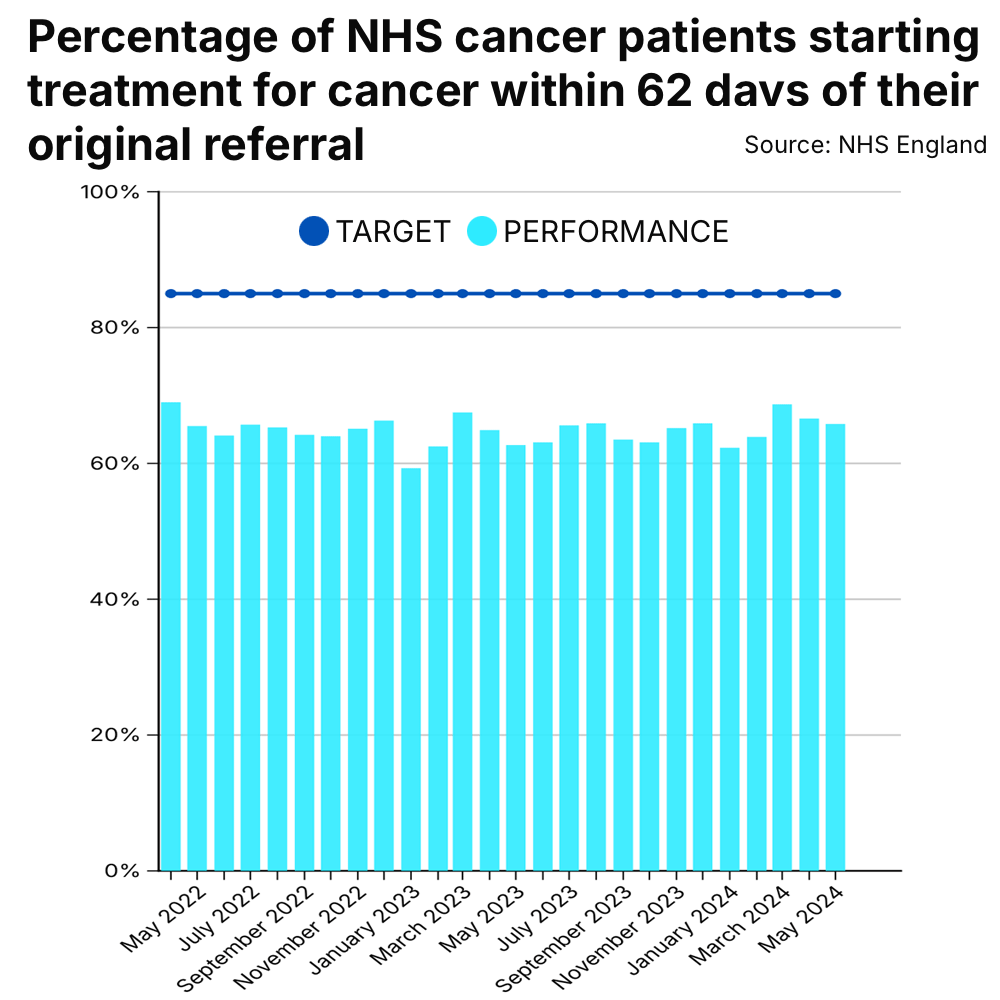
Of the 273,810 urgent cancer referrals made by GPs in May, 76.4 per cent were diagnosed or had the disease ruled out within 28 days. The target is 75 per cent. NHS guidelines state 85 per cent of cancer patients should be treated within this timeframe. Under NHS policy, the health service must review all waits over 104 days to confirm if any delays were avoidable. Reviewing the reasons for these delays, Cancer Research UK and the National Disease Registration Service found almost half in 2022 were attributed to a lack of staff or equipment.
The charity said more research was urgently needed to fully understand why the number of long waiters has increased so substantially. Michael Mitchell, Cancer Research UKs chief executive, said: “NHS staff are doing their best, but these figures are concerning. It’s positive that more patients are being treated than ever, and people are finding out if they have cancer or not faster. However, too many patients are still waiting too long to begin cancer treatment, and this report highlights how far there is still to go. A long-term cancer strategy is needed to deliver on their commitment to bring cancer waiting times down, by providing our NHS with the equipment and staff it desperately needs to diagnose and treat patients on time.”
Leading oncologist and chair of Radiotherapy UK, Professor Pat Price, also told MailOnline: “The near tripling of three-month cancer treatment delays is nothing short of a tragedy. Every four weeks of delay in cancer treatment can increase the risk of death by 10 per cent. These statistics represent people and are further evidence of the lethal legacy that Labour faces on cancer. Disparities based on age and location are being exacerbated by the fact we do not have a dedicated national cancer plan in this country.”
17th Health & Protection Magazine – Vitality Sees 45% Increase in Claims Over The Last Five Years
Vitality saw a 45% increase in the proportion of members claiming between 2019 and 2023 according to it 2024 Health Claims Report released today. Vitality said: “This increase in claims has significantly exceeded the dip in activity seen due to lockdowns in 2020, indicating that this trend is here to stay.
A significant driver of the increase has been higher demand for Vitality GP services. From 2019 to 2023, Vitality saw a sixfold increase in virtual GP consultations, and said it had delivered 95% of consultations within 48 hours. Vitality said: “With private GPs access ranking as the top feature customers would like to see within their health insurance, according to our recent survey, it has become an integral part of any comprehensive health insurance product.”
Vitality commissioned independent research on 1,000 UK health insurance customers for the report, to understand their attitudes towards health insurance. In other findings the report also showed a 179% increase in member use of talking therapies since 2019. The insurer also found that 42% of people want health insurance that supports them to be healthier and live longer, and 60% wanted a policy that it makes it quick and easy to access care.
29th The Times – Junior Doctors Offered 22% Pay Rise to End Strike Actions
Junior doctors should accept the government’s offer of a 22 per cent pay rise even though the deal has “significant defects” and they should “rightly be sceptical” about it, one of their union leaders has said. The offer was made on Monday to end the long-running dispute over pay and conditions that has caused the cancellation of hundreds of thousands of NHS appointments and operations, contributing to a record waiting list of 7.4 million people.
Speaking on Times Radio, Dr Robert Laurenson, co-chair of the British Medical Association’s (BMA) junior doctors committee, warned that doctors could strike in the future if pay was not increased in line with recommendations. The offer, if accepted, will deliver an additional pay rise of between 3.71 per cent and 5.05 per cent on top of their existing pay award for 2023-2024. It will be backdated to April 2023.
Each part of the pay scale will also be increased by 6 per cent, plus £1,000, as recommended by the Review Body on Doctors’ and Dentists Remuneration. Laurenson said: “I don’t think that this is a good deal. I think that this is the best deal possible but I think there are significant deficits in it, and I think doctors should be rightly be sceptical about it.”
Junior doctors in the BMA will now vote on whether to accept the deal and end 15 months of strike action. While the committee has recommended that they should accept the offer, there is no guarantee they will agree, given that their original demand was for a 35 per cent rise. In real terms, the pay deal means a doctor starting foundation training in the NHS will see their base pay increase to £36,600, up from about £32,400. A full-time doctor entering speciality training would have a basic pay rise to £49,900 from about £43,900.
Laurenson said: “I do think that they should consider taking the deal and accepting it, but there is no future route to pay restoration and I think doctors should look very carefully at the recommendation of the Doctors and Dentists Remuneration Board next year. If it does not adequately address pay restoration, then I’m concerned … that there will be further industrial action in the future.
*******************************************
That’s your lot for another month good people, which I trust that you enjoyed! The take-away from August:- Proactive analysis with subsequent prevention is always better than cure / the pandemic has heavily impacted the already severely under-pressure cancer/oncology arena / private medical insurance claims have escalated significantly since the pandemic, in particular remote services / and GPs now, following nurses and consultants last year, are seriously threatening strike action – If you’re rightly concerned about these issues and would like to talk to a 26 year industry experienced private medical insurance professional, on a ‘whole of market’ brokerage basis, of course without cost or obligation, please give me a call today! Until September, take care, enjoying the rest of these summer days.
Kind Regards
Daniel P. Donoghue
Private Medical Insurance Broker
Surrey Circle Health
‘Whole of Market’ Specialist PMI Brokers